


It's All Good

How Athletes Can Benefit From a Snoop Dogg Approach to Sport
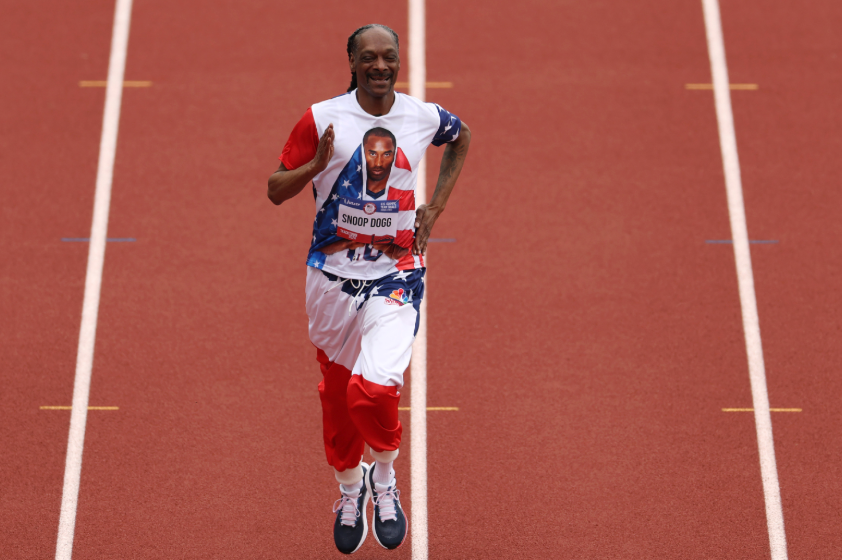
If you were building a master class on how to stay relevant, unfazed, and oddly joyful under constant scrutiny, you could do worse than start with Snoop Dogg. The man shows up everywhere now: Olympics, cooking shows, youth sports sidelines, probably your group chat if you’re not careful. At the Paris Olympics, he was less a guest and more a roaming reminder that reinvention is not a phase, it is a lifestyle. Somehow he has managed what athletes are often told is impossible: learn and grow constantly without losing yourself in the process.
When I was a young competitive athlete, I wasn't just a girl who ran, I was a runner. My personal growth was limited to lessons learned on the track, and setbacks felt like the end of the world. I did not yet have the range that someone like Snoop Dogg demonstrates so effortlessly, the ability to be fully committed to something without being fully defined by it. But then again, I was a teenager.
In college, I saw athletes who carried this same burden. Some struggled with their health, restricted eating, and overtrained to the point of injury. Like an artist who believes their worth is tied to one hit song, these athletes tied everything to their numbers. While dedication is valuable, problems arise when an athlete’s entire sense of self becomes that narrow. Helping athletes build a more expansive identity has become central to my work.
I have one example of a swimmer who took on a leadership role within his team. When he began to experience shoulder pain, he ignored it to fulfill the role he believed he had to play. One surgery later, he missed the entire season. There was no flexibility, no room to step back and adjust, something Snoop Dogg has shown in how he sustains longevity through adaptation.
A rower came to me struggling with negative self-talk and anxiety. She had grown accustomed to rapid progress, so when PRs in her 2k test did not come as quickly, frustration set in. When she described herself as the “fun, motivational teammate,” she did not smile. It was job, and in that moment, she could not allow herself to enjoy it. In contrast, Snoop Dogg shows that identity can be fluid, layered, and authentic rather than something fixed that we do to avoid disappointment.
In both examples, the athletes had locked themselves into roles they thought were expected of them. Those roles became so set in stone that they could not imagine any other way of being or any other path for their lives. That rigidity is the opposite of growth, and contributes to so much athlete anxiety.
Here are some strategies I use to shift that mindset:
1. Expand Identity Beyond Sport
Encourage athletes to explore interests outside their sport such as hobbies, friendships, or creative outlets. A broader identity creates satisfaction and reduces pressure.
2. Reframe Self-Worth
Shift from “I am my results” to “I am going to get the most out of me today.” “I failed” becomes “I improve with every mistake.” Emphasizing effort and resilience builds a stable sense of self. The focus becomes consistency and improvement rather than proving.
3. Normalize Setbacks
Injury, loss, and plateaus are part of the journey. I often ask, “What can you get out of this?” Setbacks have a beginning and an end, they are not your identity.
4. Develop Reflective Practices
I use the 3 PPQs: What went well? What did I learn? What will I do differently next time? Reflection builds awareness and choice. It helps athletes step off the “predetermined path” and realize there are many ways forward.
5. Foster Supportive Environments
Language matters. Instead of “You’re a fast runner,” say “That was a well-executed race.” You are focusing on the actions of the person, not the person. Parents can ask questions that spark curiosity such as “What part of your training helped you bring the confidence today?” or “From your experience, what challenges do you feel ready for?” This reinforces growth over labels and keeps identity flexible.
Ultimately, the goal is to help athletes develop something close to a Snoop-Dogg “it’s all good” vibe, not in the sense of shrugging things off, but in the sense of staying loose enough mentally to keep moving. When that shift happens in an athlete, I can see it immediately. Sport stops being a place where identity tightens and starts being a place where it expands. It becomes rocket fuel for personal freedom, self-expression, and confidence. And once an athlete gets a taste of that, it's a little like hearing the right beat drop in a Snoop song for the first time. You do not want to go back to silence, or to anything that makes you play smaller than you are.